What’s up?
So, today’s topic is one of the most used verbs in all Portuguese. As usual, I am actually a little uncomfortable explaining this verb because dar has so many meanings, and I get so many questions from my students that it was hard for me to decide what was going to be left out. I didn’t want to overwhelm my readers with too much information. So I decided that this post would be about the core meaning of dar, and that’s it!
The core meaning of
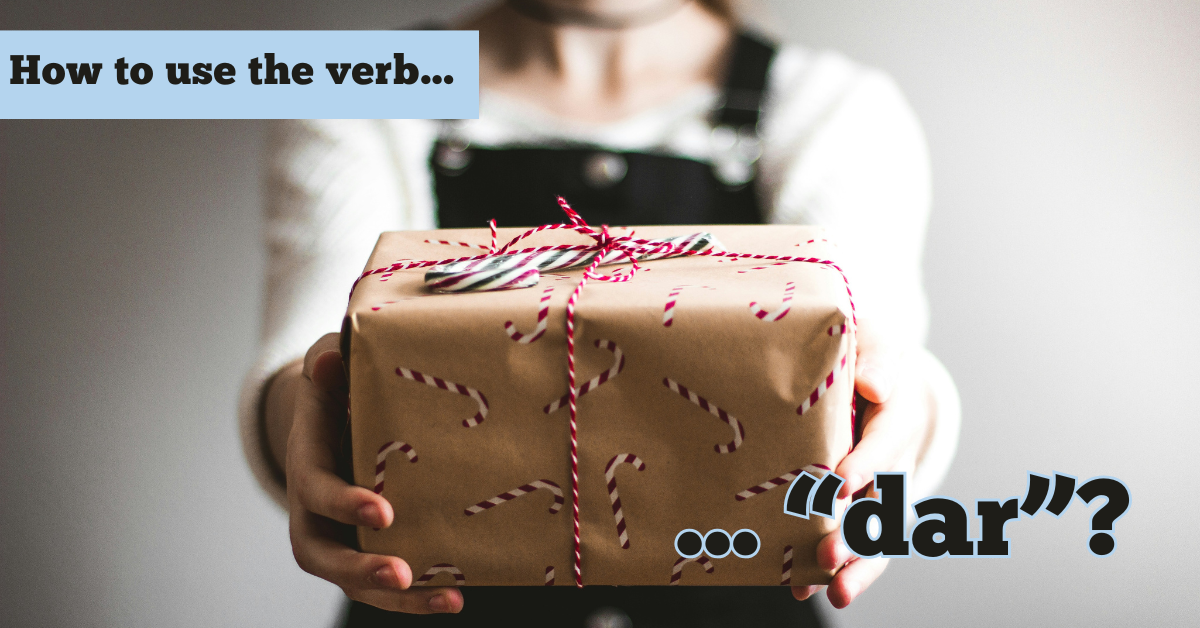
daris to give something to someone.
First, we are going to look at a few examples of dar in its “base form”.
Ele vai dar um presente pra ela.
He will give her a gift.
Eu não tenho nada pra te dar!
I have nothing to give you!
Ele queria dar um presente pra ela, mas não sabia o que escolher.
He wanted to give her a gift, but he didn’t know what to choose.
Acho que ele pode dar isso pra ela mais tarde.
I think he can give this to her later.
Ela não gosta de dar conselhos.
She doesn’t like to give advice.
Eu não sei o que te dar.
I don’t know what to give you.
Pare de me dar ordens, mané!
Stop giving me orders, idiot!
That’s it! A nice, short introduction to dar in its base form. As you can see, the core meaning is basically the same as to give in English. Practice the examples above out loud, focus on meaning rather than translation.
A few conjugations
And now, we are going to look at the most common conjugations of dar, especially in the past tense.
Ele não me deu o relatório da semana.
He didn’t give me the weekly report.
Eles são muito dedicados. Eles dão tudo de si.
They are very dedicated. They give everything they’ve got.
Minha mãe dava um beijo na minha testa antes de dormir quando eu era pequeno.
My mom used to kiss me on the forehead before I went to sleep when I was little.
A melhor coisa que meus pais me deram foi valores.
The best thing my parents gave me was values.
Nenhum presente poderia ter me dado tanta alegria.
No present could’ve given me so much joy.
Ela deu à luz três lindas meninas.
She gave birth to three beautiful girls.
Você pode me ajudar me dando um pouco de dinheiro!
You can help me by giving me some money!
Ela me deu um livro.
She gave me a book.
Ele te deu uma casa de presente e você ainda não tá contente?
He gave you a house as a gift and you still aren’t happy?
Como vocês não me deram uma resposta mais cedo, eu fiz tudo sozinho.
Since you guys didn’t give me an answer earlier, I did everything by myself.
Eles nunca me deram nada.
They never gave me anything.
That’s it! Of course, this short article doesn’t cover everything there is to know about dar, but it does show you the most common use of the verb: to give. As you dive deeper into Portuguese, you will see dar popping up in very strange contexts and meanings, especially in idiomatic expressions and collocations such as: dar um jeito, dar uma de João sem braço, dar pra, dar uma olhada, etc. It’s one of the broadest verbs in Portuguese. I do intend to create more articles about these expressions and the verb dar, but for now, you should focus only on its basic meaning.
Now, review the flashcards to cement your knowledge of dar. You are going to use and hear this verb everywhere, so learning it isn’t optional.